What’s a guy gotta do?

**Editors note: I originally published this post on our Advanced Reporting class blog.**

Why don’t people care about tuition increases? Is it something we did? Is it something we said?

Because I’m always a little hurt when the things we’re writing about for higher education aren’t consistently on the most read list, and you never seem to hear Joy praising the analytics of the most popular “strategic financial planning and assumptions” article.

Tom told you higher education is the company in the company town. George Kennedy told you that MU is a $2 billion business and that MU’s weekly payroll is around $16 million. Hell, in Columbia, you can’t spit without hitting something funded directly (or indirectly) by higher education.

So tell me, what do we need to do get people’s attention? How do we convince people of the importance of every Board of Curators decision?

We write articles, we tweet, we blog, we make graphics, we share, we engage — I even wrote an opinion piece in December, after the announcement of the new president. At this point, I’m not sure what we haven’t tried.

But I think I know what makes the difference: I see the connection from curator to student in every decision the board makes.

For people to care, they need to see what I see. To do that I think we need to come up with something new — something very different — to get people’s attention.

But I just haven’t quite figured out what that is.

The Chronicle and how state funding is changing

This morning I spotted a very interesting read from the Chronicle of Higher Education about performance-based funding’s growing popularity among legislatures around the country.

The idea is that funding schools based on their performance in particular measures (think graduation rates, professional certificates awarded, credit hours completed, etc.) would reward the most efficient schools while squeezing the most out of every education-allocated state dollar during tough economic times.

Last fall, Missouri adopted performance measures and I covered them pretty thoroughly (and skeptically) in my reporting.

But the end of the Chronicle’s article hits on an important point that I’ve heard here in Missouri. When I spoke with UM System admin Nikki Krawitz last fall, she pointed out that the higher ed relationship goes both ways — while colleges and universities have to do more with less, the state bears plenty of responsibility to get those schools the resources they need.

Over the long term, that trend toward regulatory freedom will only increase, Mr. Reindl says, especially as the states’ shares of college budgets gets smaller. “Campuses,” he says, “are coming to lawmakers saying, If you are not going to give us as much money, should you really have the same amount of control?”

In December, UM Chancellors Leo Morton and Brady Deaton told the Board of Curators they’re under pressure from donors who feel they’re money is just supplementing state support. From my article about the December board meeting:

Deaton said several donors he has spoken with have said they will not continue to give to MU if state support keeps dwindling, specifically because they don’t want their money filling a funding gap created by the state.

Now, Missouri ranks 45 out of 50 in state funding per capita in higher education so it’s fair to say that the colleges and universities have been doing more with not just less, but nearly the least.

So without state support, what’s the future model of higher education for Missouri colleges, including the UM System? That’s, very literally, the multi-million dollar question.

The sorry state of state funding

Here’s what may be the most important excerpt from interim system president Steve Owen’s response to Gov. Jay Nixon’s proposed cuts to Missouri higher education:

“It is fair to ask how long we can continue to do more with less. After a decade of reductions in state support and implementation of operational efficiencies, we are near the point where either the level of funding will have to increase or the scope and quality of services will have to decrease.”

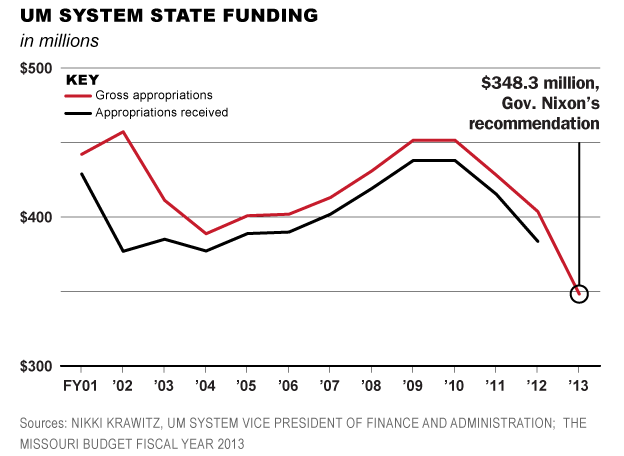
As proposed, the fiscal year 2013 budget would cut $89 million from four-year Missouri colleges and universities, including $55 million in cuts to the UM System budget.

This graphic shows the frightening decline of state support over the last decade and couple this with record enrollments for every year shown in the graphic. A $55 million reduction in funding for the UM System, a 13.7 percent decrease from fiscal year 2012’s gross appropriations. (Graphic credit to Nicole Thompson)

At its December meeting, the Board of Curators discussed a preliminary proposal to raise tuition and course fees the rate of inflation (except at Missouri S&T), but that plan was contingent on a state budget with unchanged appropriations for the system.

When that proposal was discussed in December, the system was already preparing to cover a $78 million gap, and with an additional $55 million to make up it seems highly likely that tuition and course fees will have to go up even more.

The board will discuss and vote on tuition increases at their next meeting, Feb. 2-3 at UMKC.

I hope to have more information over the next two weeks and I’ll be there in person to cover the tuition discussion in Kansas City.

For the latest on the system’s budget gap and what it means for tuition, course fees, deferred maintenance and employee salaries and benefits, stay tuned here, keep an eye on my Twitter, @zach_murdock, and check out columbiamissourian.com.

The Internet is trying to kill me and it’s all my fault

Over break I read two very good (very different) books, but one in particular reaffirmed one of my greatest fears.

The Internet is killing my brain. And it won’t stop.

Nicholas Carr’s The Shallows was one of those, “Wait, other people are feeling this too?” books, but I’m still not entirely sure that makes me feel any better.

Over the last six months especially, I’ve been feeling a change in the way I think. My thoughts seem more scattered and my ability to focus is noticeably weaker. Instead of actually reading emails or articles (or books), my attention span has been reduced to the size of a tweet or a text. I skip across the surface of web page after web page and sometimes can’t even tell you what I’ve just read.

Apparently I’m not alone. In his book, Carr reaches way back into the history of transformative technologies and neuroscience (think Gutenberg and the printing press) to explain how changing technologies have always had an effect on the way people think. And not just as a matter of changing thought patterns — he’s talking about physically altering the way the neurons in our head communicate.

As people learn new things, the brain’s neurons physically adapt to the new task by changing the way they’re “wired.” It’s called neuroplasticity, and it’s the idea that’s killing the once steadfast notion that the make up adult brain is set in stone. It’s also how the Internet may not so slowly be killing the way we think.

Learning to navigate the web’s inordinate amount of information and constant distractions means learning to handle copious amounts of stimuli (Carr goes through an undeniably accurate 30 seconds on a computer that includes the ding of a new email, a flood of new tweets, a chat notification, on and on). Information overload requires us to multitask, that’s not news. But understanding how always skittering across the surface of all of this information changes the way our different types of memory function could be essential to understanding the Internet’s influence (good or bad) on the way we think.

In an article in New York Magazine in 2009, “In Defense of Distraction,” Sam Anderson argues that the changes to our way of thinking are making us smarter in some ways but that multitasking just isn’t a viable solution to the info-overload. Instead, Anderson talked to Winifred Gallagher, author of Rapt, about attention as a tool that can be practiced and wielded against the constant distractions the web insists on throwing at us. Anderson says:

For Gallagher, everything comes down to that one big choice: investing your attention wisely or not. The jackhammers (distractions) are everywhere—iPhones, e-mail, cancer—and Western culture’s attentional crisis is mainly a widespread failure to ignore them.

Instead of chalking up our lack of attention and deep thinking to changes the Internet is forcing on our brains, perhaps being successful in the new media world is really more about willpower and making responsible attention choices.

Even sitting here writing this long post I’m feeling the effects of a shorter, weaker attention span. I can’t write more than 75 or 100 words without having to look up at something else, check my phone or get up and walk around.

So this year I’m making an effort to be more aware of my focus. No more lifehacks or self-help articles. I’m going to sit down and focus. I’ll just do it, using good ol’ willpower if I must.

It’s not that I feel less intelligent with my new way of absorbing as much content as possible, but I don’t think I’m ready to let go of the “deep reading” that inspired me to become a writer in the first place. I think there’s a place for both mindsets in this new landscape and I’m investing my focus in the search for the perfect balance.
Offseason wrap up

At the beginning of the fall semester I wrote a short piece about what it meant to finally have my shot at the Missourian, and I wanted to make it count. And hell, after more than 40 bylines, a theatre agreement, performance funding and a new UM System president, I think I’ve made the first impression I laid out in that original post.

But a new year brings a new semester and a new set of challenges, and it’s time to get right back at it.

All of the lessons I learned over my first semester at the Missourian were really just the foundation and basic structure of what I’d like to do as a professional journalist and writer — like a Phase 1 of the “Missouri Method” we were promised as freshmen.

But after the first reporting class for the Missourian, the method isn’t based so much structure as it is opportunity.

I’m taking Advanced Reporting this semester (and have the distinct privilege of staying on the higher education beat, which means I get to keep all those sources I’ve come to know so well) which is essentially enterprise reporting 101. It’s all the same newsroom resources without all the general assignment strings attached and that freedom will give me the chance to take on longer, more challenging pieces within the higher ed beat.

There’ll be more investigation, more analysis, bigger issues and harder hitting reporting. I’ll have more time to settle in to a big work and make it a reporting masterpiece.

So after a semi-hiatus from (almost) all things work this winter break, I’ll be back in Columbia Saturday to get to work on “what’s next.”

On the slate now are a few things I can talk about, and a couple of things I want to keep secret (for now).

Obviously UM System tuition increases will dominate the coming weeks, but I want to get a good jump on one of my secret ideas and hopefully have something really substantial out in the next four or five weeks.

Issues like e-Learning, the system retirement plan and even (dare I say) an MU diversity course requirement could be major players in 2012.

But not to get ahead of myself, what’s most important is to plug back in to the Columbia community and settle down for what should be the most challenging — and hopefully satisfying — semester I’ve had yet.